By Alfred (Chip) Kahn, IV, CEO and Founder, OvationCXM
Two articles published last week tell dramatically different stories.
In the first, Visa, BILL and Billtrust announced a live pilot that allows a customer-owned AI agent to pay buyer-approved supplier invoices. Two days later, some of the largest U.S. banks blocked customer AI agents from moving money after admitting they cannot distinguish AI agents from customer logins or be certain agent activity is authorized.
However, blocking customer-owned AI agents is not a durable long-term strategy, and the data proves it.
Commercial clients use AI agents and plan to expand use
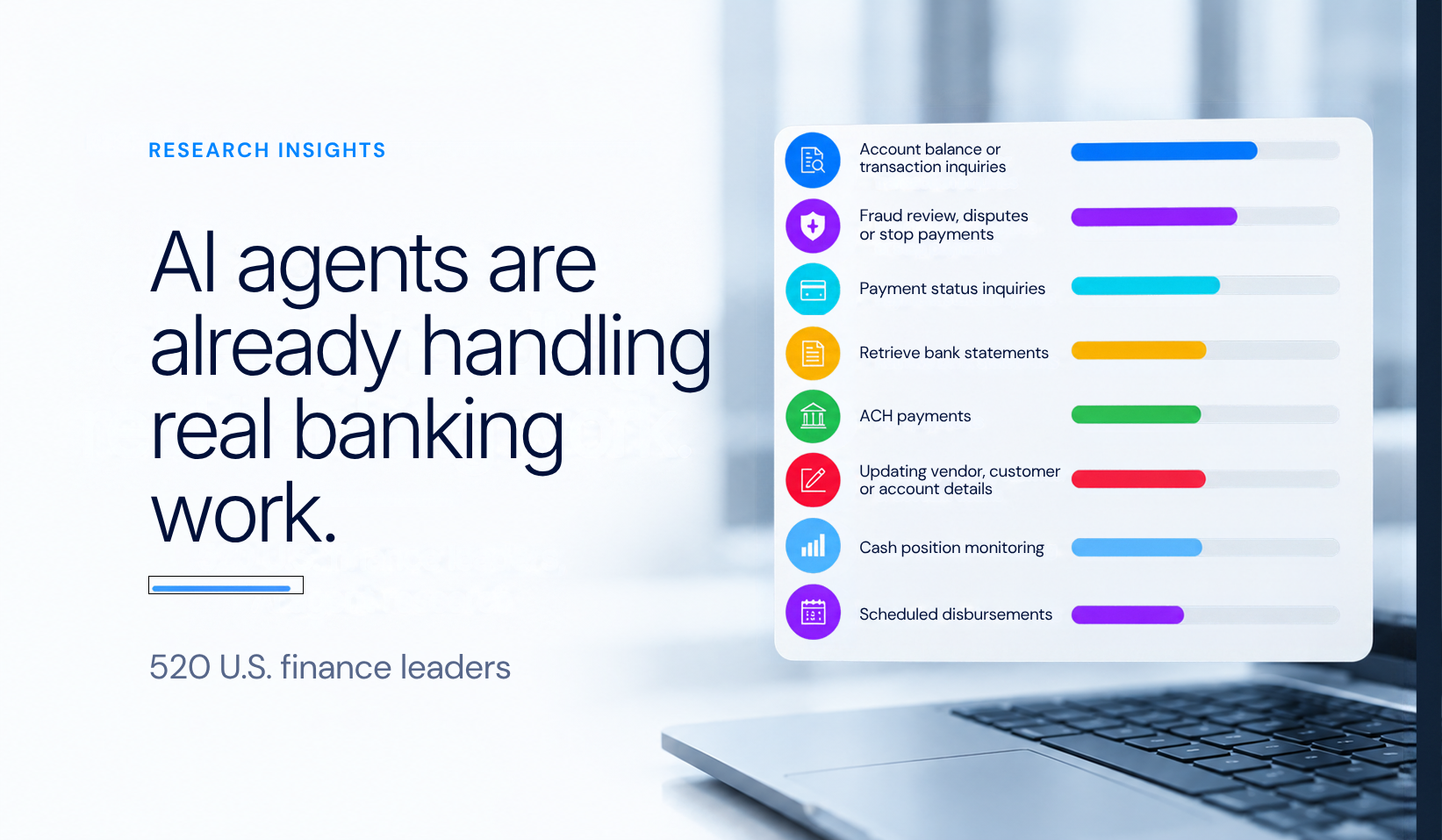
Commercial customers tell us they are using AI agents in their finance work. We recently surveyed 520 finance leaders, from small businesses to large enterprises, and 75% are using or piloting AI agents in their finance and banking work.
They are using agents inside a broad swath of tools: general AI engines like ChatGPT and Gemini, collaboration workspaces like Teams and Slack, spreadsheets, accounts payable software, ERP and others.
While the news cycle focused on “rogue agents,” customers more often give AI agents their credentials to access systems. Even with the customer’s approval, these borrowed credentials pose a problem.
When agents log in with a customer's password, the bank cannot identify the user as an agent or validate that the customer has authorized it to act, or enforce intended thresholds or controls. But boarding up the bank's front door isn't the answer either.
The demand is already here: customers want to use AI agents
Commercial customers want to use agents, according to our AI readiness survey, which discovered 72% would allow agentic AI to act in their banking workflows if it were secure and compliant, and 69% would pay their bank for AI-agent connectivity, including 83% of CFOs.
And if they are already using agents, more than half of finance leaders we surveyed said they would find a way around their bank to keep using agents. Fifteen percent said they would move more of their business to another bank that would support AI agents.
Winning customer relationships and deposit dollars is costly and difficult, so anything that causes disintermediation or loss of the account should be jarring.
Customer experience (CX) no longer applies only to human customers; it has expanded to include AI agents. Banks have no choice - as their customers move deeper into agentic banking use cases, institutions have to broaden their definition of CX to include - and orchestrate - optimized agent experiences (AX).
So, what's the answer? Allow agents into the bank after they pass through a governed front door or control layer that extends bank identity and authorization controls to AI agents, ensuring they act within preset customer and bank controls throughout a transaction lifecycle.
Know Your Agent (KYA)
This is being called Know Your Agent (KYA), and it extends Know Your Customer (KYC) processes to AI agents as a new type of user. If you cannot identify agents, you cannot control them. It includes four steps:
- Detect. Identify the AI agent, the provider and the customer deploying the agent, binding them together. In essence, KYA extends KYC.
- Validate. Determine the type of authority the agent has been given by the customer, and compare it to the specific request it is making. Determine where human approvals are required or thresholds limit action.
- Authorize, pause or block. If the action is authorized within the customer's permissions and bank policies, allow it. If it falls outside of the rules, pause it and route it for human confirmation, known as Human-In-The-Loop (HITL) or block it.
- Orchestrate. Orchestrate the agent’s path with guardrails, enforcing rules and controls from end to end while preserving an audit trail of decisions and actions.
Actions to get started governing AI agents
Banks do not need a new core or APIs. Instead, they should deploy a governed layer that sits in front of existing bank systems. Every AI agent must pass through this checkpoint, which verifies its identity, confirms it has authority for what it's requesting, and then applies those limits and rules throughout the action.
OvationCXM has created this governance layer, the Agentic Transaction Control Layer (ATCL). It is in market, production-ready and being tested with top 25 U.S. banks. It allows institutions to reuse the controls they already have, including entitlements, limits, dual approval and OTP. Once the agent is identified and registered, the bank allows it in, but with rules and controls governing what the customer’s agent can do.
Why is a control layer important for banks?
AI agents will inevitably continue to act on behalf of customers. The question isn't whether to allow them. It's whether banks will be prepared with infrastructure to manage the identity, authorization and controls required to govern AI agent activity, or they will allow these workflows to move elsewhere.
Our team has developed a series of field guides that provide detailed roadmaps for banks to think through preparations for agentic banking. They are available for download on our website. See the link in the comments below. Or, if you are working through this now, feel free to reach out to me.
We have developed some resources on this topic which can be found here: https://www.ovationcxm.com/resources/ebooks