.svg)

Field Guide: Know Your Agent (KYA) for Banks
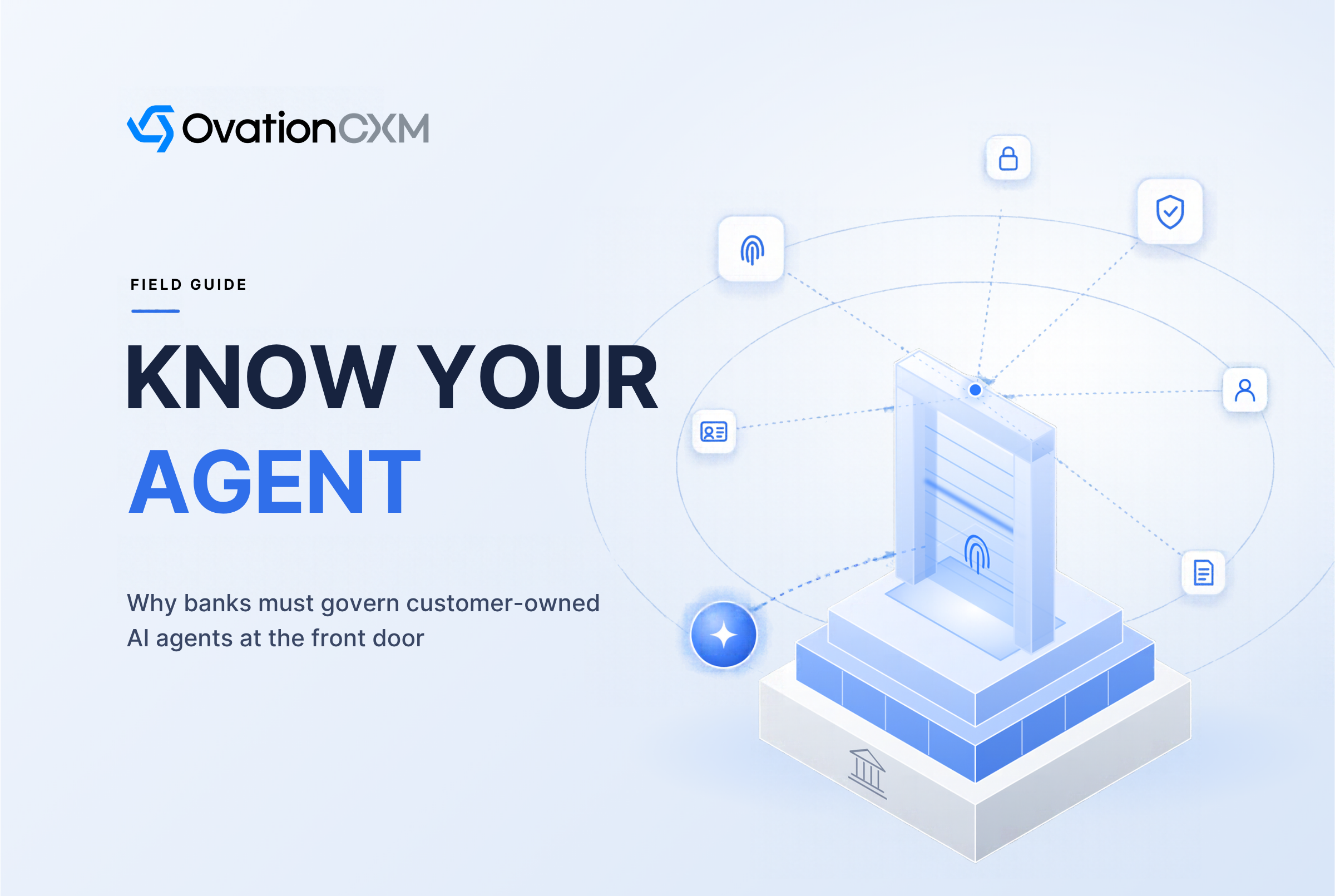
Know Your Agent (KYA) is a governance framework that lets a bank identify a customer-owned AI agent, connect it to the customer and accountable owner it represents, and decide in real time what that agent may do. Just as Know Your Customer (KYC) rules must be satisfied before a commercial banking relationship begins, KYA must be in place before an autonomous AI agent transacts on a client's behalf.
KYA goes beyond agent identification. A bank may know what an agent is and still need to establish who it represents, what it has been authorized to do and whether that authority covers the specific request.
Connectivity answers whether an agent can reach the bank. KYA determines whether the agent can act once it arrives.
Why banks need KYA now
Customer-owned AI agents are moving from research to execution. They will reach your bank from ERPs, treasury platforms, AP and AR systems and general-purpose AI tools, none of which the bank controls. Unlike a human user, an agent can originate outside your channels, operate across many systems and make requests at machine speed.
Clients want this. In OvationCXM's 2026 survey of 522 U.S. finance leaders, 88% said they would use agentic AI in banking if it were secure and compliant. 69% would pay their bank for connectivity that enables AI-initiated workflows. Blocking agents outright is not a long-term strategy, but letting one connect cannot mean letting it act without oversight.
The question for banks has changed:
From "Do we allow AI agents?" to "Under what conditions can this agent perform this action for this customer?"
The seven questions every bank should answer before an agent acts
- Identity: Which agent is making the request?
- Representation: Which customer or corporate entity does it represent?
- Ownership: Who is accountable for the agent?
- Authority: What has the agent been authorized to do?
- Context: Does that authority apply to this request, amount, account and circumstance?
- Control: Should the request be allowed, routed for approval, escalated or blocked?
- Audit: Can the bank reconstruct what happened, why and under whose authority?
Three principles of KYA governance
- Non-human identities need accountable owners. Every agent action must trace back to an authorized human or corporate entity.
- Runtime controls are required. Identity, authority, purpose and scope are validated on each request, not once at sign-up.
- Auditability is built in. Risk, compliance and audit teams can reconstruct any agent action without filing an engineering request.
What's inside the field guide
The guide turns KYA from a concept into an operating model your risk, compliance and technology teams can act on.
- The rise of agentic banking: why customer-owned agents need governance at the front door, and how to assess your bank's exposure in the next 12 to 18 months.
- The KYA model: the minimum registration record every agent needs, and why banks should fingerprint the agent, not just the credential.
- The KYA lifecycle: the 7-step runtime path from "agent arrives" to "audit record written," plus the four levels of instant, granular revocation.
- Operationalizing KYA at scale: three practical steps for building KYA into onboarding, runtime policy and orchestration, including when an agent's behavior should trigger a re-review.
- The audit record: the fields risk and compliance should be able to see for every material agent request.
- Actions to get started: checklists for each section, from defining ownership rules to piloting KYA with a small set of corporate clients.
Who this guide is for
- Heads of commercial and corporate banking, treasury management and payments
- Operations and servicing leaders
- CIOs, CTOs and enterprise architects
- Risk, compliance and AI governance teams
- Digital transformation and product leaders
Know the agent. Govern the action.
For banks, the opportunity is not to open or close the front door to AI agents. It is to control what happens after they arrive.
Read our latest research on how finance leaders are using AI agents in finance and banking work today and their plans for the next 12 months.
Other eBooks
.png)
.png)
.png)
Receive monthly CX News


© 2026 OvationCXM. All rights reserved.
OvationCXM, DBA of Boomtown Network Inc.