.svg)

A new kind of customer will soon show up on banking rails: software. AI agents, systems capable of independently initiating and completing complex financial tasks within established rules, limits and approvals, are beginning to automate aspects of financial workflows. Many of these workflows require bank-side execution, from transferring funds and reconciling accounts to processing payments.
Financial services providers on the other side of this activity are evaluating how prepared they are for non-human interactions that come through automated channels. To understand how the inclusion of AI agents in banking will affect operations, OvationCXM surveyed 522 U.S. finance leaders. We asked them questions about their current finance workflows, their comfort and willingness to pay for bank-supported connectivity to enable AI agents to automate tasks, which workflows are top priority and what they would require from their bank to feel comfortable using agents for banking.
Key research findings
The OvationCXM survey results were surprising.
Overall, they indicated that a large number of finance leaders are already planning the deployment of agentic AI into their most resource-intensive workflows, and many of those involve their bank. The majority are also willing to pay for connectivity that enables AI agents, if it is safe and compliant.
Finance leaders told us:
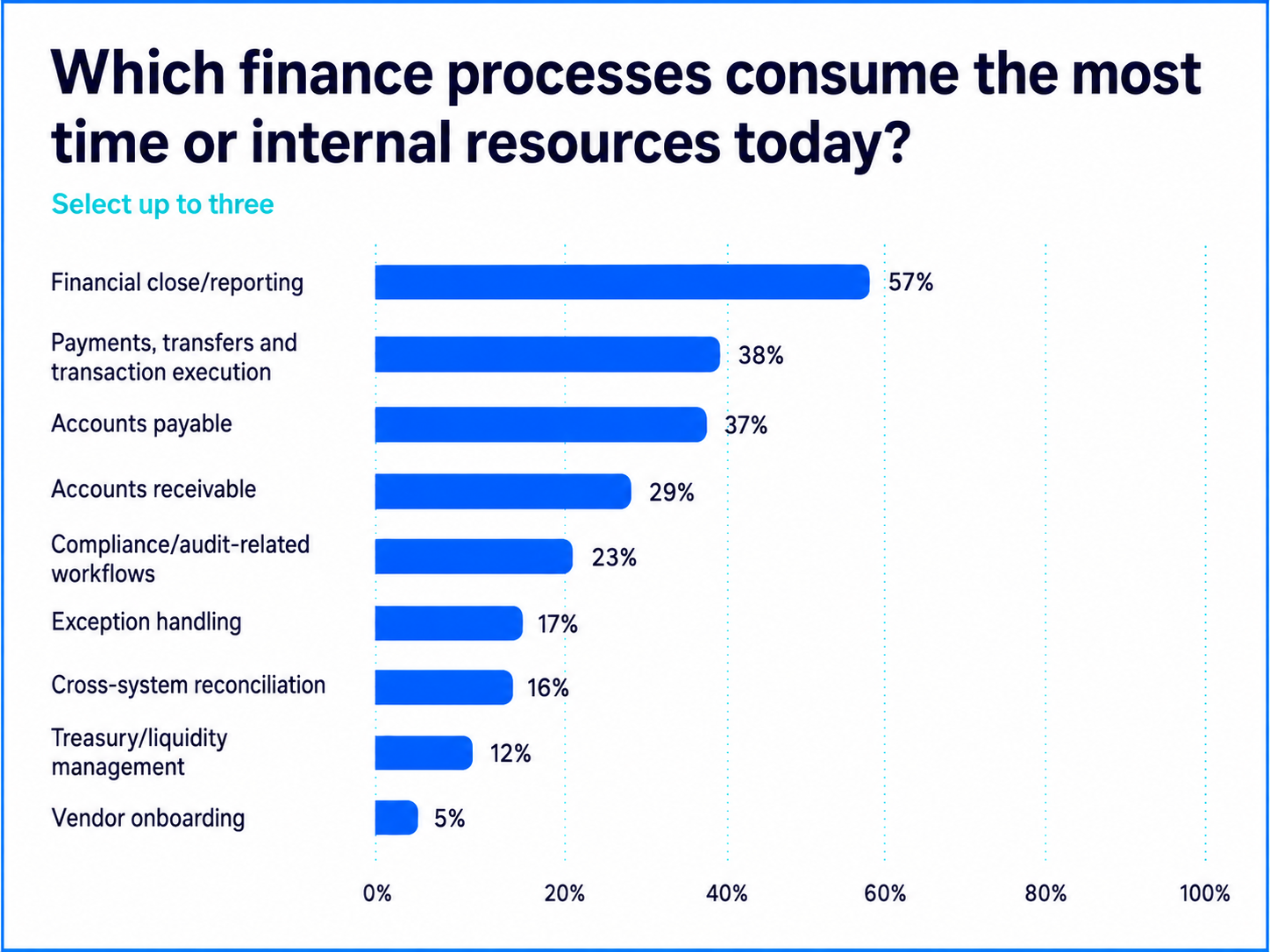
- Resource-intensive workflows tend to be banking related.
- 76% already use automation or AI in banking-related workflows
- 47% of non-users plan to adopt agentic AI within the next 24 months
- 71% say agentic AI capabilities influence whether they choose or expand banking relationships
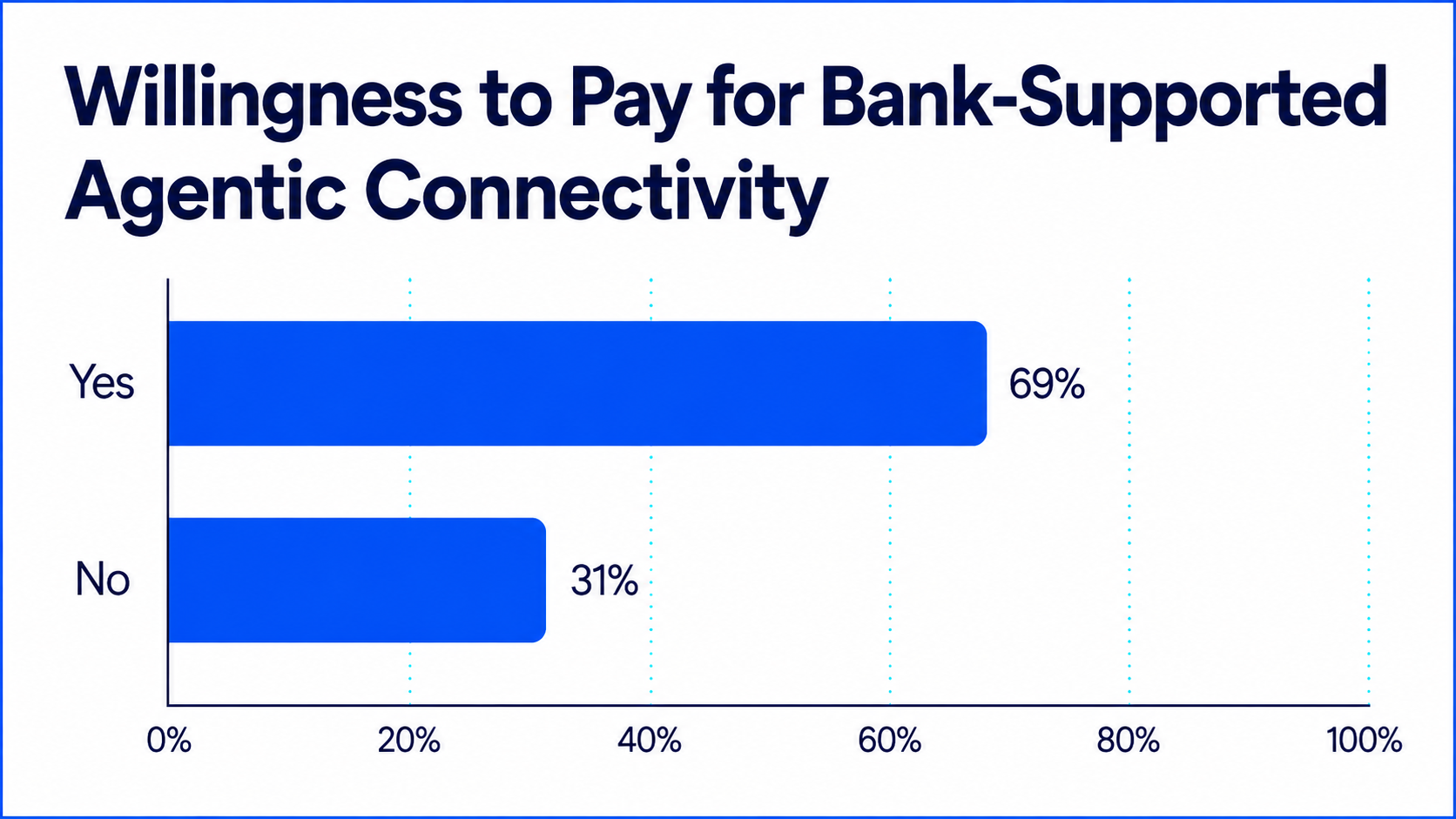
- 69% would pay for bank-supported agentic connectivity
- 88% would allow autonomous workflows to run banking tasks if appropriate controls are in place
The message is clear: automation is already a large part of a typical finance team's workflows, and they are actively moving toward agentic banking in the next two years.
What is agentic AI in banking?
For this research, OvationCXM defined agentic AI as systems that independently initiate and complete multi-step financial tasks within established rules, limits, approvals and governance controls.
In practice, that means an AI agent could:
- monitor balances and liquidity positions
- initiate payments
- transfer funds between accounts
- reconcile transactions across systems
- coordinate treasury workflows
- execute routine financial processes
Traditional automation may automate a step, but humans still need to advance it to the next step. AI agents can initiate actions in sequence to complete an entire process. This autonomy effectively creates a new type of banking user, requiring unique configurations and controls.
Does automation maturity predict higher comfort with agentic AI?
Finance teams have spent years investing in technologies to streamline workflows, and agentic AI represents the next step in that progression. Our research found that 76% of finance leaders already use automation or AI in banking workflows today, and the further along they are in automation maturity, the more comfortable they are with agentic AI. Among organizations already using AI tools specifically, more than three quarters are comfortable with agentic AI use, nearly twenty points higher than the overall sample. As automation use expands within a finance team, comfort with agentic AI grows too.
Where do finance teams want to deploy agentic AI first?
Among finance leaders not yet using agentic AI, nearly half plan to implement it within the next 24 months, and banking workflows are at the top of their list due to their cumbersome nature. When respondents were asked which finance tasks they plan to expand AI agents into within the next two years, the top five were:
- financial close
- accounts payable
- accounts receivable
- cross-system reconciliation
- payments, transfers, and transaction execution
Noticeably, most of these rely on the bank in some way, making it imperative that institutions can receive, validate, and govern the instructions and activities these AI agents initiate. This is no longer a long-term prediction. It is a near-term transformation of banking channels and customer interactions.

Is agentic AI connectivity becoming a factor in bank decisions?
One of the strongest findings in the research was not about technology; it was about buying behavior. Seventy-one percent of finance leaders said agentic capability is a factor in whether they choose or deepen a banking relationship. Nearly 2 in 10 said it is a primary factor. The conclusion? Agentic connectivity will be a competitive advantage for some institutions in the very near future and a retention risk for others.
This commercial demand will also create a new revenue opportunity for banks, in the same way online banking did a decade ago. Opening up another convenient channel is worth paying for, according to finance leders. Nearly 7 in 10 say they are willing to pay for bank-supported connectivity that allows agents to act, moving this from a future opportunity to a near term offering that can be monetized. The full report provides the specifics on the roles and companies most willing to pay for agentic banking.
What agentic AI controls do finance leaders require from banks?
In OvationCXM’s research, finance leaders provided a clear list of capabilities they would need in order to feel comfortable using AI agents in banking tasks. It is a near-perfect description of a control layer between agents and core systems, including fraud detection, configurable permissions, transaction confirmation, audit trails, and override capability. Without those capabilities, AI agents can be hijacked, unauthorized transactions can occur, and a bank may be unable to explain money movement to clients or regulators. A governed layer is the foundation for “Know Your Agent,” extending identity, control, and audit trails beyond humans to software and agents.
How can banks prepare for agentic AI?
The challenge finance leaders are describing is not simply an AI challenge. It is an orchestration challenge. Agentic readiness is an orchestration problem before it is an AI problem. Banks must coordinate authentication, permissions, approvals, workflows, systems, teams, and auditability across a growing network of participants that includes both humans and AI agents.
That is difficult to do without a control layer that can connect and govern activity across applications, departments, and external partners. Banks that establish this capability will be better positioned to receive, manage, and monetize agent-driven activity. Banks that do not may still be involved in the transaction, but increasingly pushed behind the scenes.
Get the full research report
OvationCXM’s agentic AI banking research provides a deeper look at the coming agentic age of banking.
The full report includes:
- Which role is most comfortable with agentic AI, and which is most reluctant
- Which companies would be most willing to pay for agentic connectivity, and who is most willing in the buying group
- specific features finance leaders need to feel comfortable using an AI agent for banking
- strategic implications for banks and financial institutions
Download the full report to explore what 522 finance leaders revealed about the future of agentic banking.
Methodology
The OvationCXM 2026 Agentic AI Readiness Survey gathered responses from 522 U.S. finance leaders, including CFOs, controllers, treasurers, finance managers, and heads of finance. Respondents represented organizations ranging from under $5 million to more than $1 billion in annual revenue. The survey was fielded in April 2026 through Centiment, an independent research panel.