.svg)

On June 29, 2026, U.S. Senator Mark Warner unveiled a discussion draft of the Artificial Intelligence Access, Gatekeeper Exchange, and Nondiscriminatory Transfer Act - more simply dubbed the AI AGENT Act.
Ostensibly written to protect consumer choice and regulate autonomous bots, the bill seeks to establish a federal framework to address the growing shift from a human-centric web-browsing model to an agentic, machine-to-machine ecosystem. More specifically, it proposes a federally backed ecosystem registry of secure “custodial user agents” allowed to act on behalf of individuals across large online platforms. In doing so, this framework will help promote market competition, protect consumer choice and ensure data security.
From a product and platform perspective, however, this draft is a massive signal to the financial services industry. By forcing online platforms with 50 million or more users to open their interfaces to third-party agents, the bill lays the groundwork for how transactions will be initiated, routed, and cleared in an agent-first economy.
If consumer-facing tech platforms dominate this newly regulated agent tier, they will capture the primary relationship interface - a significant interface disintermediation risk for banks and payment companies. If an external AI agent completely manages the discovery, negotiation, and execution of commerce on behalf of a consumer, the traditional bank portal or mobile app may be rendered invisible. Financial institutions risk being pushed out of the customer-facing loop and relegated to silent, back-end utility rails.
To ensure they are well-prepared for the future, banks must transition their digital strategy from designing human User Experiences (UX) to provisioning highly secure, machine-readable Agent Experiences (AX).
So, what is the AI AGENT Act about?
At its core, the AI AGENT Act of 2026 is the first piece of federal legislation designed to codify the legal and technical relationship between autonomous software and online ecosystems. It focuses on three main pillars:
- Defining Custodial User Agents (CUAs): The bill defines a CUA as an AI system explicitly authorized by a human (whether an individual or a business) to act as their digital representative. Essentially, an AI assistant that you legally authorize to go do things for you across the internet - like booking a trip, managing your emails or handling your personal finance accounts.
- Ascribing Duty of Loyalty: CUA providers must adhere to a fiduciary-like "duty of loyalty," meaning the agent must act in the user's best interest, limit data monetization, and maintain real-time logs of all actions.
- Mandating platform interoperability: Any giant online platform with 50 million or more users (think Amazon, Meta, or TikTok) is legally required to let your certified third-party AI agent access their platform. They cannot block your agent just because they want you to use their own in-house AI tool.
- Creating a Centralized Trust Registry: The U.S. Federal Trade Commission (FTC) will manage a public registry of approved, certified CUA providers. If an agent isn't registered, a platform can legally block it - a crucial trust signal for any software hoping to perform real-world commerce.
- Establishing open protocols: The National Institute of Standards and Technology (NIST) is tasked with establishing industry-wide, open consensus technical protocols. This step will enable different systems to securely verify an agent's identity and approve actions without friction.
The Product Challenge: Probabilistic Intent vs. Deterministic Execution
To understand why the AI AGENT Act is a massive technical wake-up call for banking and payments, let’s take a step back and look at how software is built.
- AI Agents are probabilistic: Large Language Models (LLMs) and autonomous agents operate on probabilities. They guess the next best word, action or API call. They are highly dynamic, conversational, and designed to interpret loose human intent.
- Core banking is deterministic: Regulated ledger systems, payment networks, and compliance engines operate on absolute, black-and-white certainty. They require strict, deterministic inputs. There is zero room for an AI to "hallucinate" a routing number, guess an account balance, or approximate a corporate wire transfer.
So, as it stands, there is a mismatch between how consumer AI agents work and how regulated core financial systems execute tasks.
If a customer’s CUA attempts to interact directly with a bank's traditional, human-facing APIs or web portals, the results can be catastrophic. Without a protective boundary layer, agents are prone to using broad API keys that leak sensitive personally identifiable information (PII). Alternatively, they may brute-force scrape user interfaces, compromising bank system performance and exposing the bank to adversarial prompt-injection exploits.
In short, without a secure gateway to control them, letting autonomous AI agents interact directly with traditional banking systems is like letting a self-driving car navigate a busy highway without brakes - it won’t be long before a bad prompt or a system overload causes a major crash.
Banking and commerce customers are already building and using agents to scrape portals invisibly. Without a structured front door, financial institutions risk losing both the transaction audit trail and security control.
The Solution: OvationCXM's Agentic Transaction Control Layer (ATCL)
To bridge this gap, financial institutions must deploy a bank-side transaction control plane that sits squarely between incoming, probabilistic external agents and the bank's deterministic internal systems.
OvationCXM’s patent-pending Agentic Transaction Control Layer (ATCL) acts as this secure proxy and financial firewall, translating AX into compliant, automated banking actions. It does this by providing the essential rules and technical protocols that keep the system safe:
- Standardizing on Open Protocols: The ATCL relies on emerging consortium protocols so the bank does not have to write custom integrations for every new AI tool.
- Enforcing Task-Level Least Privilege: Instead of exposing broad, unrestricted API keys, the ATCL strictly limits incoming agents to "least privilege" configurations, ensuring that an external assistant can access only the precise data points required to execute its immediate, authorized task.
- Human-in-the-Loop (HITL) Safeguards: For sensitive, high-risk transactions, the ATCL immediately freezes the transaction. It forces the agent to stop and mandates human approval via a traditional out-of-band One-Time Password.
- Forensic Audit Trails: Unlike standard LLMs, which struggle to record the reasoning behind every automated step, the ATCL captures and stores a complete, trace-level forensic record of the agent's logic. This ensures full compliance with the real-time record-keeping mandates outlined in Senator Warner's draft bill.
The Time to Act is Now
The AI AGENT Act of 2026 proves that the federal standardization of agentic commerce is no longer a question of if, but when.
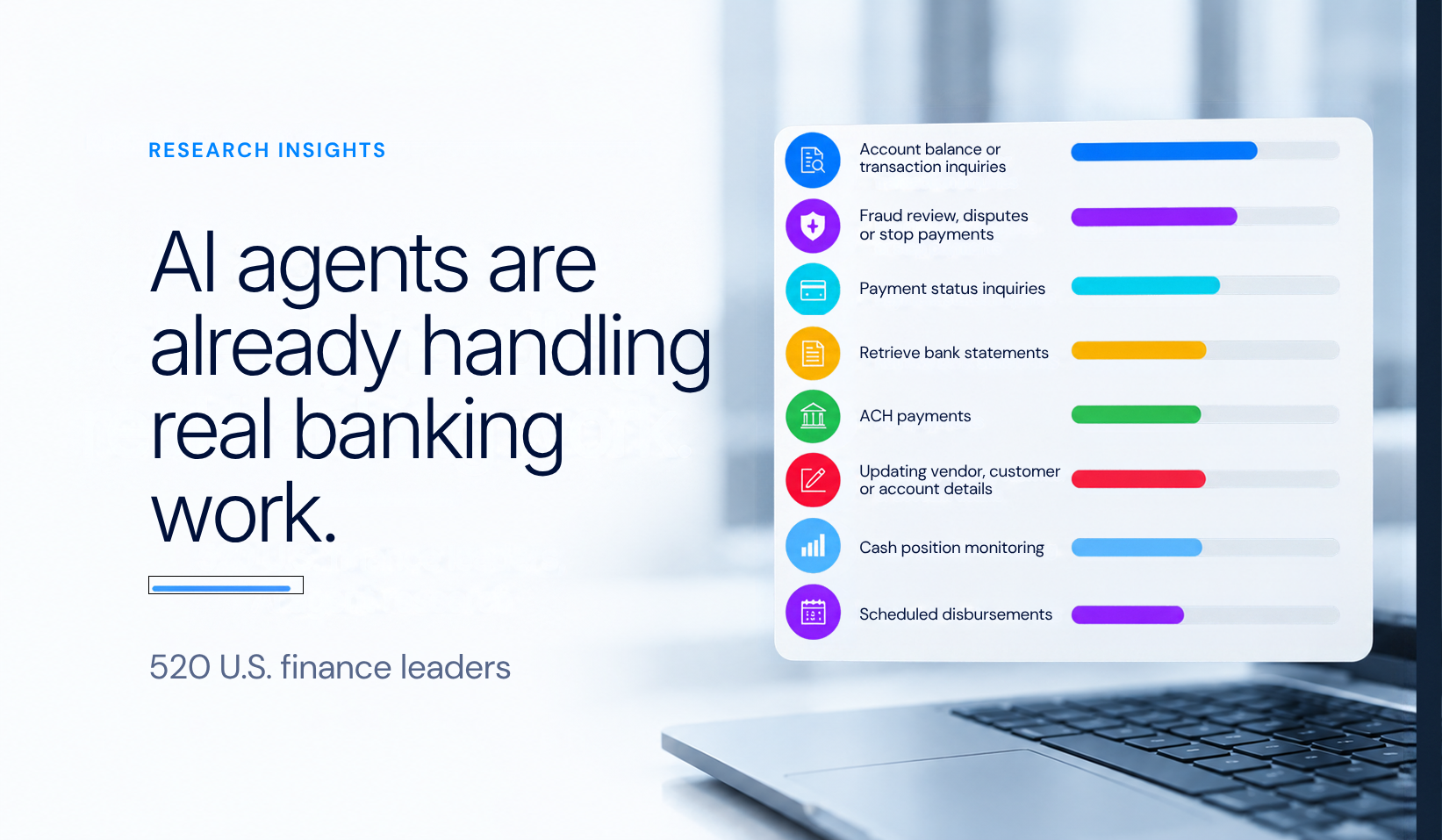
The question facing financial institutions today is no longer whether your clients will use autonomous agents: 63% of finance teams are already leveraging transaction automation, 88% would use some form of secure agentic workflows, and 69% are willing to pay for dedicated bank connectivity that enables AI-initiated workflows. The real question is whether your bank will have the infrastructure in place to govern, permit, and monetize those transactions.
Many institutions believe they are avoiding risk by not supporting agents. In reality, their customers are already using agents to scrape their portals invisibly, leaving the bank without an audit trail or security controls. By deploying OvationCXM’s ATCL, you can rapidly translate existing human workflows into machine-readable execution paths without a costly, multi-year core system rip-and-replace. Financial institutions can safely open their digital front door to the machine-to-machine economy - capturing new transactional revenue while retaining absolute control over security, compliance, and forensics.
Schedule Your ATCL Briefing
Learn how your organization can turn unmanaged machine traffic into a secure, revenue-generating banking channel. Explore our patent-pending technology or schedule your complimentary executive briefing today.