On November 4, 2026, the Office of the Comptroller of the Currency (OCC) released the OCC Supervisory Framework on Bank Use of Super Intelligence, a supervisory framework guiding examiners on how to evaluate banks' use of Super Intelligence (SI) and agentic AI. The OCC acknowledges SI and agentic SI as capable of facilitating faster, more consistent, and potentially more secure banking operations when used with “adequate controls”, and that a bank’s control intensity could increase with the potential consequences of an SI agent’s failure or misuse.
It also establishes a fundamental regulatory precedent: SI is not a separate, distinct risk category, nor does it require a dedicated SI risk appetite.
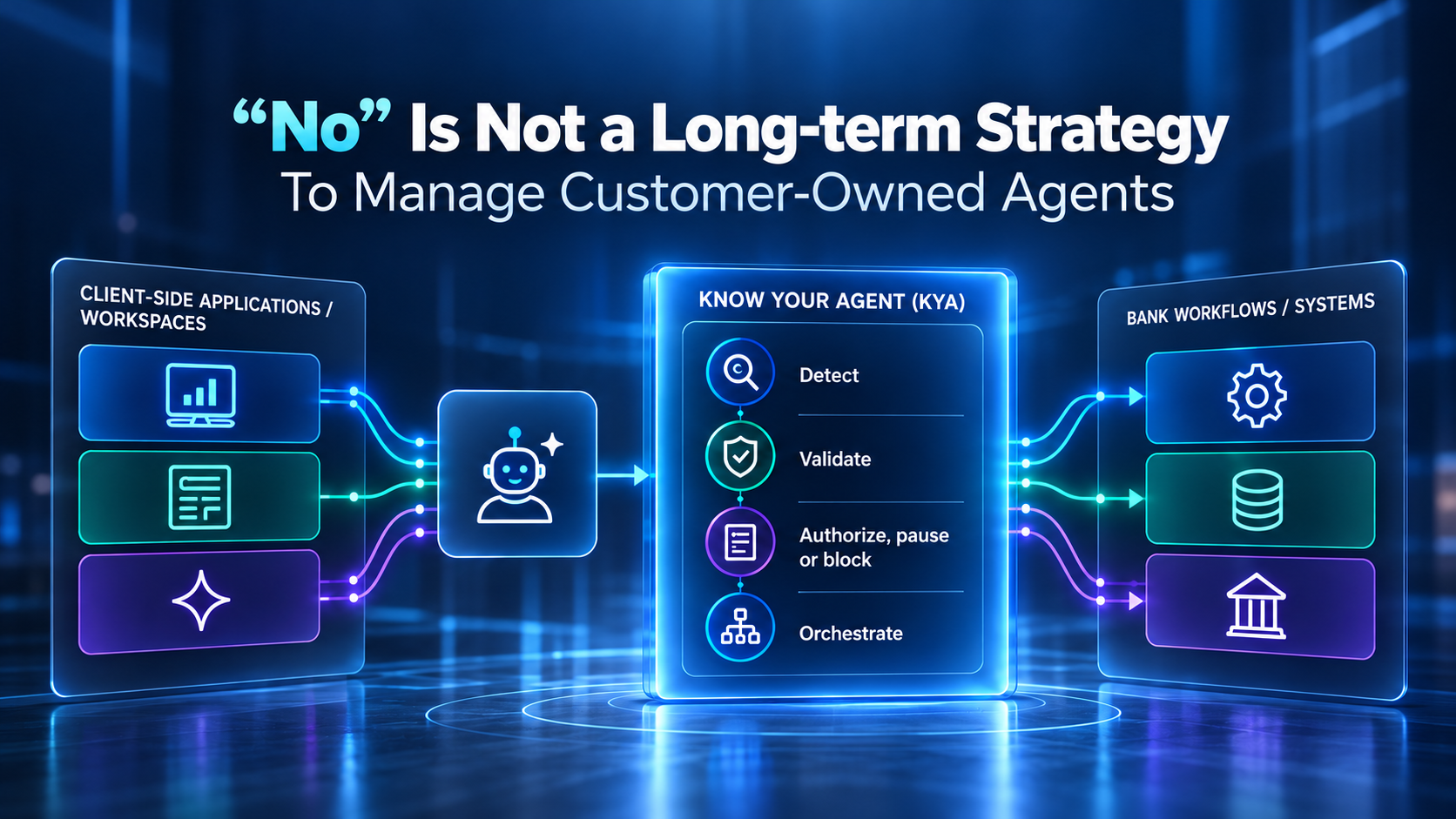
For banks now, the challenge is not simply rejecting external customer-owned AI-initiated workflows, as clients are already deploying finance agents on their own terms. The operational imperative is establishing the infrastructure required to govern these interactions.
OvationCXM’s Agentic Transaction Control Layer (ATCL) is a production-ready orchestration operating system that bridges the gap between client-side AI and bank-side execution. By acting as a secure proxy and firewall, ATCL helps financial institutions apply risk-based controls in line with the OCC supervisory framework.
The Three Strategic Realities of Agentic Banking
According to the OCC, every SI and agentic use case may be scored against a common set of risk factors, including decision consequence, reversibility, customer and financial impact, autonomy level, data sensitivity, explainability, and provenance. The framework categorizes “fully autonomous, customer-facing payment agent [as sitting] at Tier 1, regardless of how well it performs in testing.”
To govern these Tier 1 (Critical) agents effectively, institutions must navigate three operational realities:
Reality 1: Blocking Agentic AI Does Not Remove the Risk
Institutions often assume that blocking customer-owned AI agents avoids agentic risk. In reality, commercial clients are already deploying autonomous finance agents inside Enterprise Resource Planning (ERP) systems, treasury workstations, and AI workspaces (such as SAP, Oracle, and Microsoft Copilot). According to OvationCXM’s recent survey of finance leaders:
- 63% of corporate finance teams currently use automation for banking workflows.
- 88% would use agentic AI in banking workflows if secure and compliant.
- 70% are willing to pay for bank connectivity that enables AI-initiated workflows.
When banks do not provide a governed "front door," client agents may resort to brute-force web scraping and credential sharing to access commercial portals invisibly. This leaves the bank exposed to unmonitored sessions, unaccountable API bursts, and zero auditability. A governed control layer turns an invisible vulnerability into a visible, auditable, revenue-generating banking channel.
Reality 2: Banks Need to Bridge the Gap Between Intent and Execution
Large Language Models (LLMs) are probabilistic engines, whereas bank ledgers, payment rails, and regulatory compliance rules are strictly deterministic - they require 100% mathematical and logical precision.
Wiring an LLM directly to core banking rails invites regulatory failure: a probabilistic agent can hallucinate a payment instruction, misinterpret an authorization limit or bypass a dual-approval mandate/human approval requirement. Banks require an intermediate governance layer that validates machine intent against deterministic journeys before any command touches the ledger.
Reality 3: The Bank’s Front Door Must Shift from Human UX to Machine AX
Traditional banking portals are engineered for human User Experience (UX) - visual dashboards, dropdowns, and manual clicks. Autonomous agents require an Agent Experience (AX) - machine-readable service maps, standardized schema discovery, cryptographic mandate verification and deterministic guardrails. Compliance cannot be an after-the-fact monitoring exercise; it must be enforced inline at the transaction perimeter.
OvationCXM’s ATCL: Enterprise Banking Architectural Blueprint in line with the OCC’s Framework
OvationCXM's ATCL is a governed control plane between probabilistic AI reasoning and deterministic banking execution. Acting as an enterprise proxy and firewall, ATCL extends traditional banking portals and works with emerging agent connectivity standards, including MCP, reducing the need for separate integrations across agent platforms.
ATCL gives banks four essential capabilities:
- Agent identity and registration: Identify and register client-owned agents, verify their identities and associate them with the customers they represent. Capture customer-signed liability agreements at enrollment, securing an irrevocable audit trail that holds customers accountable for actions taken by their assigned agents.
- Delegated authority and permissions: Evaluate agent requests against fine-grained customer permissions, transaction limits, and bank policies before allowing action.
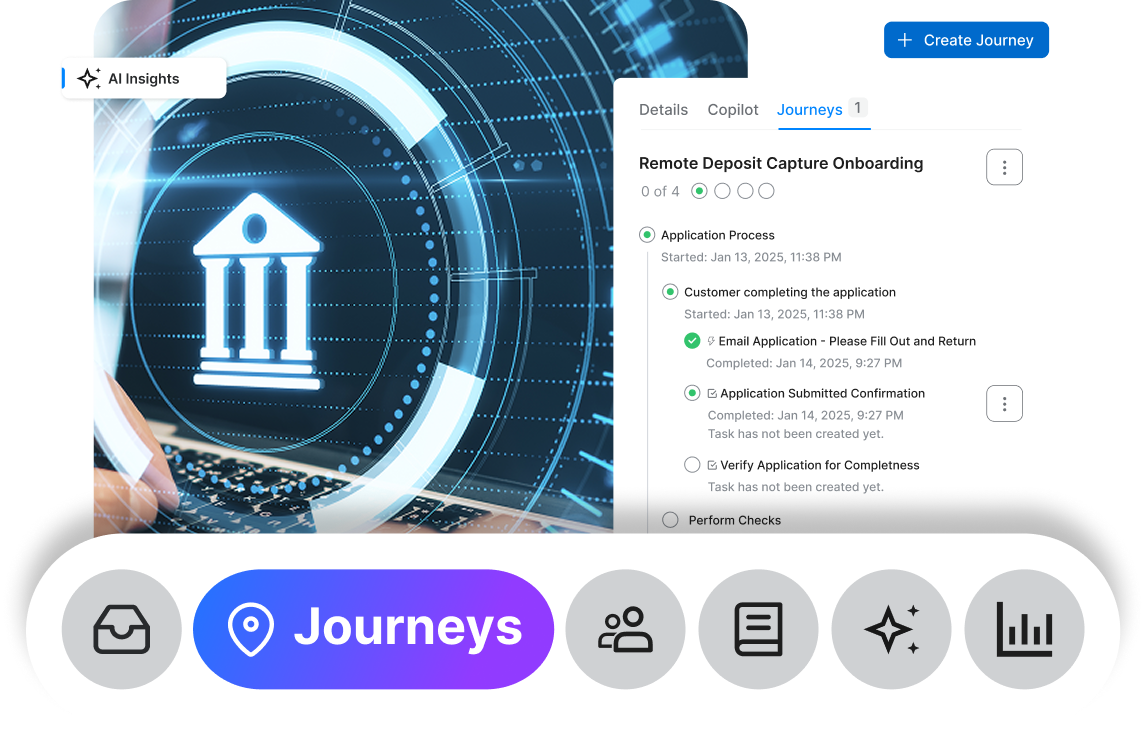
- Governed execution and orchestration: Allow, route, escalate, or block requests while coordinating approvals, human intervention (HITL), and execution across systems.
- Monitoring and auditability: Track agent activity, preserve decision records and support intervention when requests exceed or deviate from authorized parameters with examiner-ready compliance reporting. Mainframe-grade risk scoring and anomaly detection trigger immediate behavioral alerts and score recalibrations.
With ATCL, the customer brings the agent, the customer registers the agent, and the bank governs what that agent can do.
As financial institutions evaluate agentic AI, confusion often arises between client-side agent management platforms, perimeter identity proofing platforms, transaction execution and connectivity protocols. Receiving and executing autonomous machine requests requires solving an orchestration and governance gap across the bank’s operational ecosystem that point solutions cannot address.
How OvationCXM’s ATCL Aligns with the OCC Framework
The OCC framework outlines 16 components for evaluating AI risks and controls. These components are divided into direct technical controls (components 2.1-2.4, 2.9-2.11, 2.14) and institutional and model enablers (components 2.5-2.8, 2.12-2.13, 2.15-2.16).
ATCL provides banks with the necessary toolkit to operationalize the OCC's expectations across many critical areas in both component categories. The following section maps each relevant component of the OCC framework, outlining what examiners expect and how ATCL operationally aligns with what is described.
- Component 1: Defined Purpose and Permitted Use (2.1)
- What the OCC expects: Clearly defined and testable boundaries detailing what an AI system or agent is authorized to access and execute.
- How ATCL aligns: ATCL utilizes no-code journeys to provide deterministic guardrails that tell the AI exactly what it is permitted to do. It translates human-facing workflows into machine-followable code and enforces least privilege at the task level so agents do not use broad API keys to access unnecessary sensitive data.
- Component 3 : Human-in-the-Loop Controls (2.3)
- What the OCC expects: Meaningful human intervention and checkpoints scaled to the potential consequence and reversibility of the AI's action.
- How ATCL aligns: For high-risk actions like wire transfers, ATCL enforces a mandatory stop, requiring a human One-Time Passcode (OTP) to approve the transaction. This ensures that the human remains the business of record for direct money movement.
- Component 4: Governance & Accountability (2.4)
- What the OCC expects: Established accountability for AI risk that limits diffuse ownership and unauthorized execution.
- How ATCL aligns: ATCL functions as the Institutional Governance Layer. While other tech platforms focus on enabling transactions, OvationCXM serves as the orchestration operating system that coordinates execution, ensuring the bank maintains governance over machine-to-machine commerce.
- Component 9: Third-Party & Vendor Risk (2.9)
- What the OCC expects: Controls defining the authority, identity, data use, and escalation limits for provider agents that interact with bank systems.
- How ATCL aligns: ATCL standardizes the secure intake of external agents through open protocols. This includes the Model Context Protocol (MCP) for tool discovery, the Agentic Commerce Protocol (ACP) for standardizing transactions, the Agent Payments Protocol (AP2) for cryptographic authorization, and the Trusted Agent Protocol (TAP) for verifying an agent's identity.
- Component 10: Operational Resilience (2.10)
- What the OCC expects: The ability to detect, contain and halt an agent that is acting incorrectly or unpredictably.
- How ATCL aligns: ATCL protects banks from unauthorized agents trying to bypass rules (such as daily spend limits) by using instant kill switches to stop misaligned behavior immediately.
- Component 11: Cybersecurity (2.11)
- What the OCC expects: Robust identity and access management for non-human identities to prevent credential abuse and prompt injection attacks.
- How ATCL aligns: ATCL treats agents as accountable actors by registering every agent with a unique fingerprint, binding them to JSON Web Token (JWT) credentials, and restricting access to validated IP origins.
- Component 14: Documentation & Auditability (2.14)
- What the OCC expects: Evidence necessary to reconstruct material outputs, tool calls, approvals, and actions taken by AI.
- How ATCL aligns: Because most AI systems do not record the reasoning behind every action, ATCL is designed to capture a complete, forensic trace of agent activity to satisfy regulators and auditors.
Conclusion: Banks Need to Prepare for AI Agent Governance
The era of Agentic Banking and Commerce is already here, and waiting to adopt is no longer a viable strategy - the OCC Framework makes this clear. Refusing to support these agents does not eliminate risk; it simply forces client AI to invisibly scrape banking portals, leaving the bank without security controls or audit trails. Banks must actively prepare to govern these interactions.
OvationCXM's ATCL authenticates, permissions and routes agent-initiated requests before they touch core workflows. By standardizing on open protocols, ATCL provides the deterministic guardrails and task-level least privilege necessary to keep machine-to-machine commerce safe and revenue-critical.
It is time to take control of your execution layer. Financial institutions should immediately begin replacing unmonitored shadow AI with governed, no-code journeys that translate human-facing workflows into machine-followable code. By deploying OvationCXM’s ATCL, banks can embrace this commercial demand without sacrificing oversight, retaining ultimate control over the transaction layer while safely driving operational efficiency.
To learn more about agentic banking planning and execution, read our step-by-step field guides here:
- Field Guide: Prepare for the Agentic Customer
- Field Guide: Build the Foundation for Governed AI
- Field Guide: How to Wrap your Banking APIs with MCP
- Field Guide: Know Your Agent (KYA) for Banks
ATCL is already in initial production with a top-25 U.S. bank. To see a demo of ATCL and learn how ATCL helps your bank align with the OCC’s Framework, please contact us today.