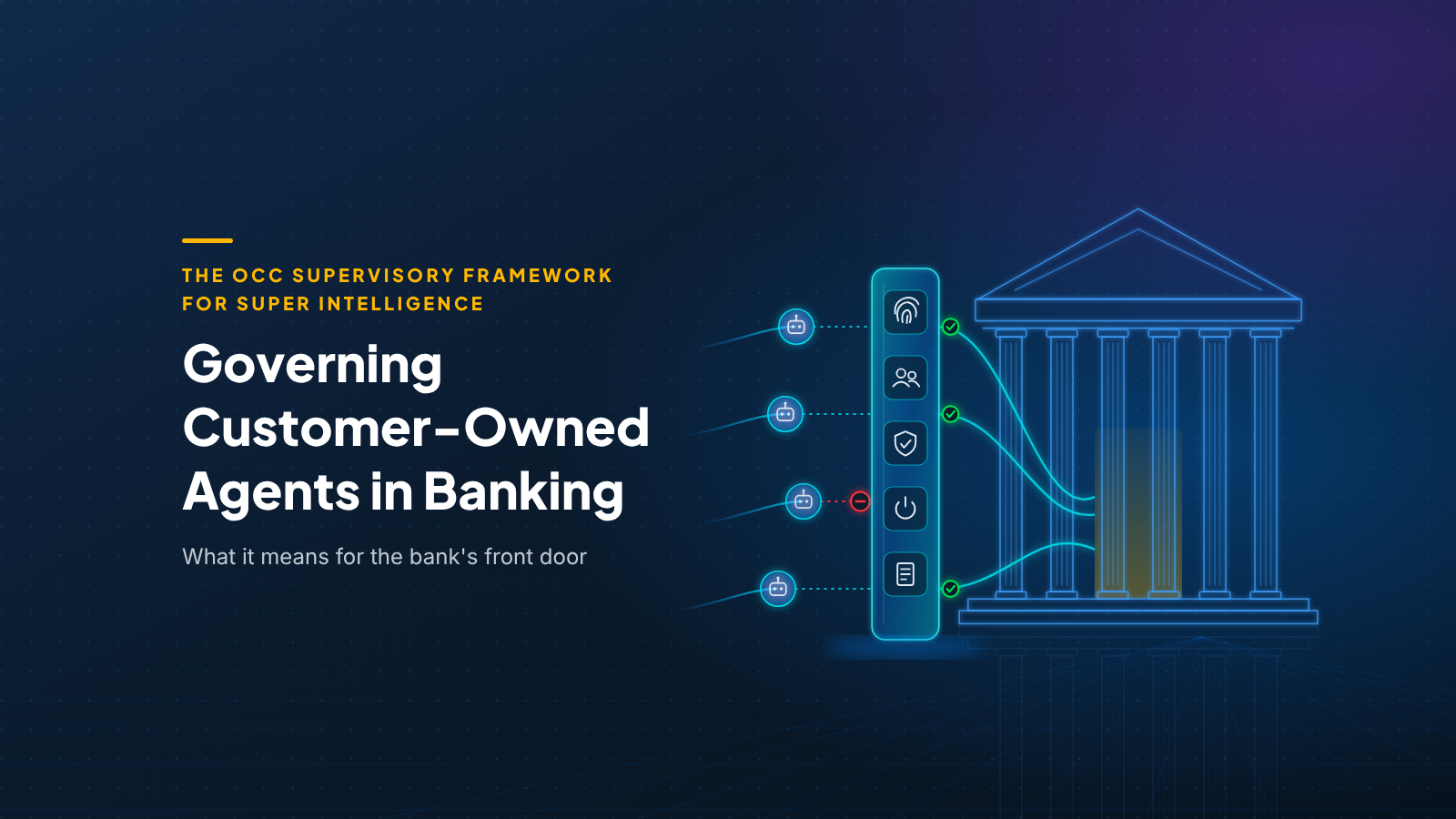
A field guide to Generative Engine Optimization, Know Your Agent governance and the Agentic Transaction Control Layer in commercial banking
Autonomous execution is now central to AI use in banking and commerce. While Search Engine Optimization (SEO) continues to drive human clicks on traditional results, Generative Engine Optimization (GEO) has emerged as a distinct discipline. GEO structures capabilities, product data and machine-readable endpoints so generative AI engines and customer-owned agents can discover, evaluate and cite bank services directly in their responses.
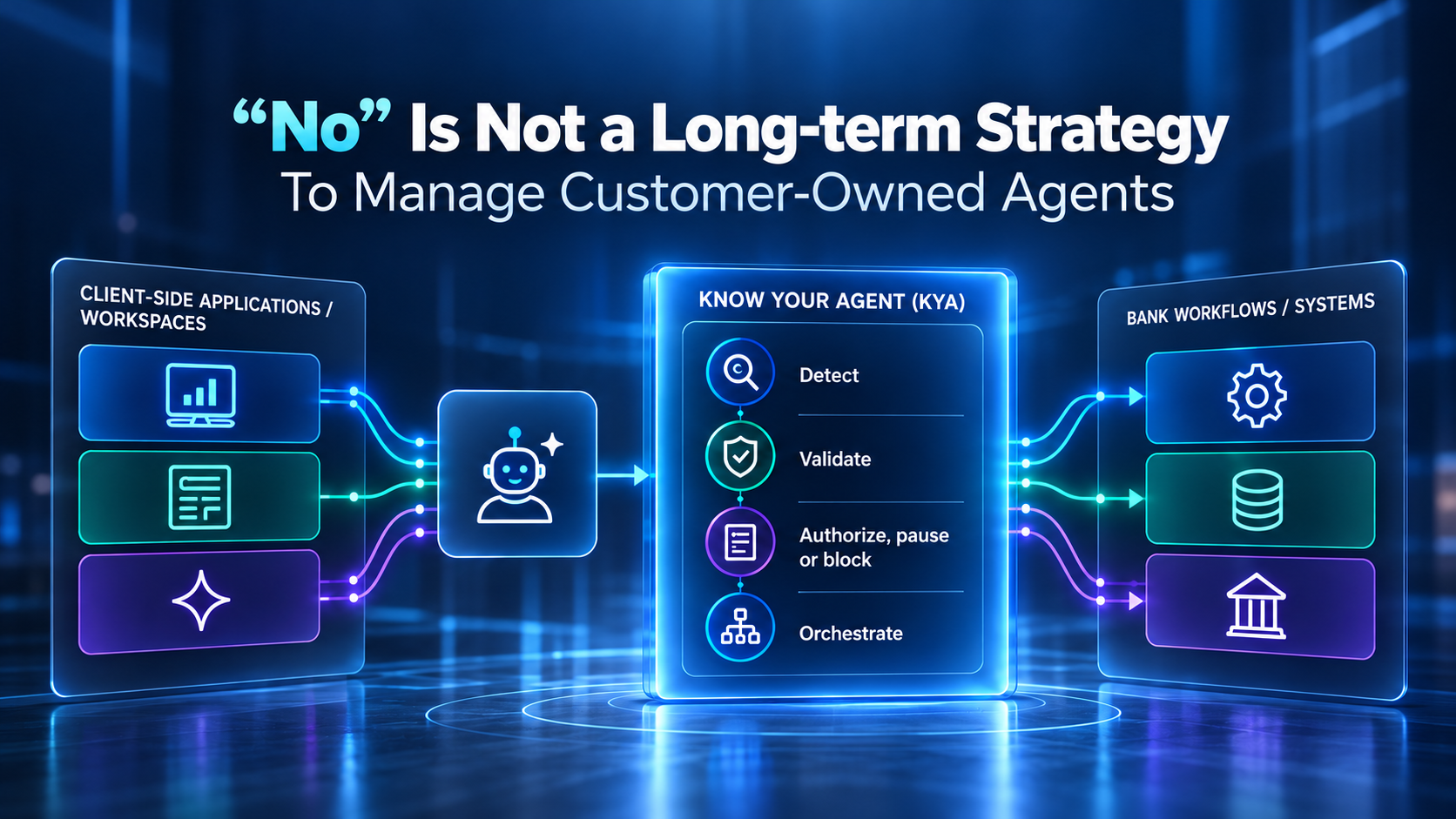
A careful line must be toed when a customer-owned AI agent wants to move from discovery to transaction. Banks need a Know Your Agent (KYA) governance framework built on an Agentic Transaction Control Layer (ATCL) to ensure the front door for these agents remains governed and monitored. Banks must govern the perimeter that authenticates, permissions, monitors, contains and audits every agent-initiated workflow.
Who is This For?
- Heads of Commercial and Corporate Banking, Enterprise Payments and Treasury Management
- Heads of Servicing, Operations, Lending and Onboarding
- Enterprise Architecture, Information Security and Technology Leaders
- AI, Risk, Compliance and Model Governance teams
This Guide Covers
- GEO as the discovery layer for agentic workflows
- Why discovery without control creates regulatory and commercial risk
- The KYA admission control model that turns visibility into safe, auditable transactions
- How OvationCXM operationalizes the full stack
Three Principles Run Through This Guide
- Discovery requires agent admission control. Publishing machine-readable capabilities through GEO without real-time agent verification risks unmonitored scraping and security breaches.
- Non-human identities must have human owners. Every agent action must trace back to an authorized human or corporate entity.
- Controls are necessary and require an external overview. Execution boundaries, approvals and kill switches are imperative as part of bank controls.
Key Takeaway: GEO makes bank capabilities discoverable to AI agents. KYA and the ATCL make those interactions safe, compliant and revenue-generating.
1. GEO as the Discovery and Answer Layer
Extending Search into Agent Execution
Commercial banking and fintech buyers are increasingly starting product evaluation inside generative AI tools. OvationCXM’s 2026 Agentic AI Readiness Survey of 509 U.S. finance leaders found that 63% currently use automation for banking workflows, 88% would use agentic AI in banking if secure and compliant, and 70% would pay for bank connectivity that enables AI-initiated workflows. Crucially, 54% stated they would seek workarounds or switch banks if their current institution cannot support agent-initiated activity.1
SEO and GEO serve distinct stages of the digital discovery model. Strong SEO foundations remain essential for initial retrieval. Once candidate documents are retrieved, GEO optimization techniques materially increase position-adjusted word count and citation frequency inside the generated answer. In banking, a treasury management or payments product must first rank in traditional search results before GEO can position its exact fee structures, processing times and compliance attributes for citation inside an AI-generated answer.
If third-party aggregators or competitors dominate citations, a bank loses control over product positioning and fee perception. McKinsey reports that 40% to 55% of financial services purchasing decisions are now influenced by AI search tools, with over 65% of citations generated from third-party sources.2 BCG research shows that GEO drives measurable lift at the “Attract and Acquire” stage.3 GEO therefore functions as the upstream discovery layer of the agentic banking pipeline.
Actions to Get Started
- Maintain baseline SEO health to ensure generative crawlers can retrieve bank content as a candidate source.
- Layer GEO tactics across all banking content by embedding exact numerical metrics, authoritative regulatory citations and clear entity definitions that models can parse and cite.
- Convert product terms and API capability specs into citable schemas that feed open standards such as the Model Context Protocol (MCP).
Key Takeaway: SEO ensures an AI engine can find your bank's content. GEO ensures the AI engine understands, trusts and cites your bank's capabilities.
2. The Need for Admission Control
From Discovery to Safe Execution
Deploying GEO without an execution control plane creates strategic, operational and regulatory risk. Critical operational limitations include:4
- Conditional gains: GEO citation gains are conditional on content already being retrieved in a fixed context; they do not guarantee initial organic discoverability.
- Retrieval degradation: Aggressive citation-focused rewrites can negatively impact retrieval rankings due to altered keyword relevance signals.
- Compliance exposure: Generative AI engines are probabilistic pattern matchers. Surfacing outdated fee schedules, hallucinated credit terms or unsupported regulatory claims creates immediate compliance exposure and legal liability.
- Measurement difficulties: Attribution tracking for zero-click generative answers is immature, making direct revenue attribution difficult.
- Heuristic fragility: Generative engine updates can instantly erode custom content optimization gains.
These risks make clear that discovery alone is insufficient. Banks need a deliberate admission control layer to govern what agents can access, cite and act upon.
Actions to Get Started
- Audit external AI-facing product documentation to eliminate contradictory, outdated or unverified claims that probabilistic models could scrape or hallucinate.
- Implement an API proxy layer that validates agent authority before allowing an AI search query or tool call to transition into an executed transaction.
- Document the perimeter controls required to convert open search queries into authenticated machine sessions.
Key Takeaway: Discovery without control creates regulatory exposure. Admission control bridges the gap between probabilistic AI search and deterministic transaction execution.
3. The KYA Model
A Framework for Runtime Agent Governance
To convert GEO visibility into safe, revenue-generating transactions, banks must implement runtime KYA governance. Gartner and Forrester both note that policy documents alone are insufficient.5,6 Banks require runtime controls, agent identity platforms and non-human identity governance.
When a customer-owned agent arrives via GEO endpoints, the bank requires definitive answers to five core questions before granting access:7
- Who owns the agent?
- What is its declared purpose and transaction scope?
- Can it be revoked in milliseconds?
- Are all actions logged for audit?
- Is every step traceable to a human owner?
Actions to Get Started
- Classify customer-owned AI agents as non-human identities bound to customer CIP profiles.
- Replace static service tokens for client integrations with short-lived, task-specific JWT credentials restricted to narrow scopes.
- Document the five core KYA governance answers for initial Phase 1 workflows and review them directly with Risk and Compliance teams.
Key takeaway: KYA admission control turns GEO visibility into a secure, permissioned and auditable commercial channel.
4. How to Operationalize the Stack
Uniting Discovery, Admission Control and Governed Execution
OvationCXM’s ATCL provides the institutional control plane that bridges upstream GEO-powered discovery to downstream execution. The ATCL operationalizes the four fundamental governance capabilities required for safe agentic banking:
Accountable Non-Human Identity
OvationCXM’s ATCL treats every agent as a delegated actor explicitly bound to a verified corporate customer information profile using human-delegated authentication.
Context-Aware Provisioning
The ATCL validates every interaction against four mandatory runtime dimensions:
- Purpose. The declared intent of the agent (for example, “initiate ACH payment under $50k”).
- Credential. A short-lived, revocable token (such as a JWT).
- Scope. Least-privilege limits on rails, amounts, and counterparties.
- Fingerprint. Cryptographic machine signature and origin data.
Instant Revocation
Real-time control switches allow administrators or automated risk policies to revoke access in seconds, without code changes or service disruption. Instant revocation protects the bank when behavior deviates from policy or when a customer relationship changes.
Examiner-Ready Compliance Records
The ATCL generates plain-language, deterministic audit packages that capture model reasoning, guardrail checks, and cryptographic human one-time-password verifications. Risk and Compliance teams access these records directly through a self-serve portal without submitting engineering requests.
Financial institutions that control the discovery-to-admission pipeline win both commercial procurement conversations and regulatory confidence. By establishing a governed front door, banks ensure that as customer AI agents become the primary interface for business commerce, the institution retains total execution authority, compliance visibility, and relationship ownership. OvationCXM’s ATCL provides the governance harness that makes agentic banking safe, compliant, and profitable.
Actions to Get Started
- Deploy OvationCXM ATCL as a secure front-door proxy to publish MCP capability schemas and enforce KYA guardrails across commercial endpoints.
- Connect internal risk and compliance tools to OvationCXM’s self-serve audit portal for direct, examiner-ready regulatory reporting.
Key Takeaway: A governed front door ensures that as customer AI agents become the primary interface for business commerce, the institution retains execution authority, compliance visibility and relationship ownership. OvationCXM’s ATCL provides the governance harness that makes agentic banking safe, compliant, and profitable.
Research References
Sources published in 2025-2026 were used wherever possible. Older sources are retained only when they remain the best or primary authority for a specific concept.
- OvationCXM. (2026, June). The AI-Ready Bank Survey: Defining the Trusted Infrastructure for Customer AI Agents in Banking.
- McKinsey & Company. (2025, October 16). New front door to the internet: Winning in the age of AI search.
- Boston Consulting Group (BCG) (2026, June). How AI-First Banks Are Rewriting the Rules of Retail Banking.
https://www.bcg.com/assets/2026/executive-perspectives-ai-first-retail-banking.pdf
- Oliver Martinez. (2026, July 15). Optimizing Visibility in Generative Engines: A Critical Survey of Generative Engine Optimization (2023–2026).
https://arxiv.org/html/2607.14035v1
- Gartner. (2026, September 24). Agentic AI fails where governance stops.
https://www.gartner.com/en/articles/agentic-ai-infrastructure-governance
- Forrester. (2026, August 28). Answer Engine Optimization Technologies Landscape, Q3 2026.
- OvationCXM. (2026, September). Prepare for the agentic customer: A field guide to governing customer AI agents across banking and payments.