For Banks That Want to Optimize Onboarding Journeys
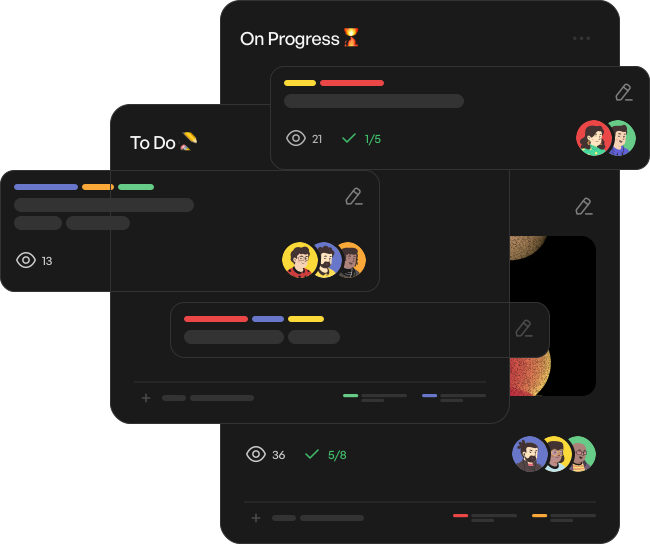
Business banking onboarding is widely recognized as a source of customer frustration. However, focusing solely on experience masks a deeper issue: onboarding failure in banking is fundamentally an operational and structural problem, not just a CX one.
This article examines why business banking onboarding breaks down systemically. Leveraging research into onboarding abandonment and coordination failures across products like merchant services, treasury management, and trade finance, it explores why existing platforms can't manage the complexity.
Taken together, these findings point to a structural gap: while banks optimize individual onboarding tasks and systems, there’s no infrastructure to coordinate execution across the full onboarding journey, particularly when it spans multiple teams, platforms, and external partners like most banking journeys do.
Onboarding orchestration has emerged to address a long-standing execution gap in business banking: enabling banks to manage journeys end to end, reduce abandonment and accelerate activation.
OvationCXM’s research shows that 25% of businesses never complete onboarding for a banking product they’ve signed up for.This abandonment happens before the first transaction, so banks accrue acquisition costs, but revenue never comes. The data shows that a product mismatch rarely causes abandonment. Instead, businesses name the primary cause as operational friction during onboarding.
When businesses explain why they disengage, several patterns emerge:
OvationCXM data shows that:
These handoffs, however, are unavoidable, especially for complex commercial banking products like commercial credit, merchant services, trade finance and treasury management. All are highly regulated and rely heavily on third-party vendors. Since this difficulty can’t be eliminated, it has to be better managed.
With numerous handoffs, communication is broken in the gap between teams, and that ultimately affects the customer. Across all commercial banking onboarding journeys, 40% of frustrations relate to information and communication gaps, including:
Fifty-one percent of businesses said they had to interact with 2-3 people to fix a single issue during onboarding. These challenges explain why onboarding feels slow, even when individual tasks or steps are optimized and completed on time. Progress stalls in between, not because work isn’t happening, but because customers and teams can’t see current journey status, what’s next, or which department or vendor has ownership.
It’s not uncommon for a bank to tap into over a dozen systems (or more!) during customer onboarding. They can include:
Business banking onboarding rarely happens in a single system or department. Each owns a portion of the process. Few share visibility of their steps with other people or platforms working the journey. As complexity increases, coordination grows too.
Banks have already invested heavily in digital onboarding tools, workflow automation and analytics, but they operate within system or functional boundaries. Workflow tools manage discrete tasks. CRM systems track records and relationships. Compliance and risk platforms validate specific requirements. Each performs its role effectively in isolation.
Business banking products, however, are delivered across ecosystems, not single platforms or teams. As a result, banks may meet internal SLAs for individual tasks while overall onboarding progress stalls or feels cumbersome to the client.
Traditional onboarding and workflow solutions do optimize parts of the process, but they do not manage the entire experience, which is what customers are judging. It’s nearly impossible to guide and support customers in real time with this limited context.
Onboarding performance directly affects revenue outcomes, so it shouldn’t be viewed only as an operational necessity. It directly affects the bottom line. When onboarding stalls:
This is why 33% of businesses cite simpler onboarding as a key factor for banks to win more of their business, according to our research.
When onboarding execution is fragmented, relationship managers and bankers spend disproportionate time coordinating across teams, chasing status updates, and managing customer uncertainty. This reduces time available for revenue-generating activity and slows progress from agreement to first transaction.
Orchestrated onboarding changes how sales teams operate. With clear, shared visibility into onboarding and activation journeys, frontline staff can:
Faster transitions from onboarding to go-live speed up first transactions, and greater coordination behind the scenes lets sales teams focus on expanding relationships, not monitoring the process. Over time, more consistent execution across business lines improves predictability in revenue realization.
Banks can deliver repeatable onboarding outcomes while still building in flexibility by product, segment, or channel. This turns onboarding from a sales bottleneck into a growth engine.
Onboarding orchestration introduces a missing execution layer. Rather than replacing existing systems or adding another point system, an orchestration layer:
CX orchestration pulls together all of the people and systems doing the hard work of onboarding customers so they can work together in a coordinated, one-team approach that simplifies the experience for customers.
Business banking onboarding is complicated, and that will not change. It’s highly regulated, and in the back office, optimizing by function makes sense. What does not make sense is maintaining the silos that create roadblocks for teams and customers.
Point solutions add more complexity to an already chaotic business ecosystem. AI automation, when only a general-purpose solution, doesn’t overcome the gaps in siloed teams and data. However, AI that is natively built into a robust orchestration engine becomes a vital feature to streamline journey design and management.
Banks that want to optimize operations must take control over the separate processes not working in tandem today. They must unify system, partner and customer interaction data, so AI has enough information to provide true insights from across the ecosystem.
A journey orchestration tool, built especially for financial services and catering to banks that rely on third-party partnerships, is the best way to organize disconnected processes into operationally smooth and efficient customer experiences.
Journey orchestration software doesn't replace existing systems - it connects them so they work together and help separate teams and partners work together as one, which is more cohesive for the customer and more efficient for the bank.
Banks that daisy chain their isolated processes into a cohesive, coordinated journey using an orchestration tool like OvationCXM have transformed business units rapidly, in months, not years.
Key Bank significantly reduced customer churn and boosted revenue, turning the merchant services division from a cost center into a profit driver using our journey orchestration platform. Read the KeyBank case study for details.
For more on commercial banking journeys, read our Trade Finance Case Study


© 2026 OvationCXM. All rights reserved.
OvationCXM, DBA of Boomtown Network Inc.
.svg)
