A Practical Guide for Banks Orchestrating Complex Ecosystems.
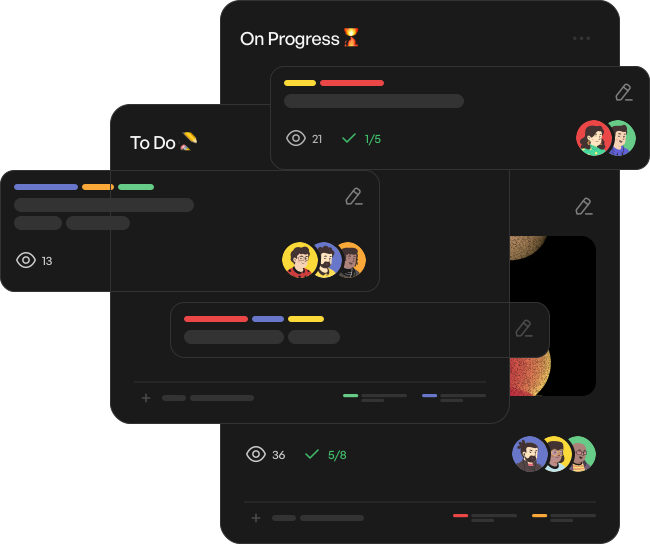
Every bank is trying to speed up onboarding and activation, increase cross-sell and accelerate revenue while minimizing churn. But those outcomes rely on one capability many banks still lack: a connected, end-to-end view of the customer journey. That is what journey orchestration solves.
Banking orchestration coordinates the work, systems, teams and third-party partners that must work together to move complex onboarding, servicing and operational journeys forward. An orchestration layer sits above existing bank technologies, from CRM to core to KYC to coordinate operational work, ensure end-to-end visibility, manage dependencies and exceptions and ensure the journey progresses through completion.
Customers may be satisfied with individual touch points, but frustrated with the financial services journey overall. In other words, optimizing individual touch points doesn’t always fix the customer experience.
OvationCXM's research into business banking trends reports that complex commercial banking products like credit cards, merchant services, and treasury management have specific pain points that can affect the banking relationship.
“It’s not just the people, processes, and systems inside the bank that make up a customer journey; it’s the entire ecosystem you depend on.”
- Tim Attinger, President, OvationCXM
This article will provide a guide to journey orchestration in financial services ecosystems. It will define what it is, why the status quo has not been effective in managing journeys and how to use technologies like CXM and journey orchestration platforms to reduce friction and accelerate revenue.
Journey orchestration is the end-to-end design, coordination and management of every step in a financial services onboarding, servicing or support process. Orchestration coordinates customer interactions across the banking business ecosystem, which includes:
Today, the journey steps that make or break a customer’s experience, from information and document collection and know-your-customer (KYC) to fulfillment and implementation, happen in different systems with different teams, using data specific to their part of the journey.
That customer data is siloed, so it’s invisible to other teams that also interact with the customer. The result is a black hole for everyone - banking teams, vendor partners and customers.
Orchestration is not workflow or process automation, which only improves specific steps. Journey orchestration streamlines the flow from beginning to end, which is how a customer experiences it. Orchestration eliminates inefficiencies and pain points that frustrate customers.
Customer journey orchestration technology answers six important questions in real time:
A journey orchestration platform should also coordinate steps that happen across its ecosystem with external vendor partners, including core providers like Fiserv, Jack Henry and FIS.
Banking is powered by legacy technologies that are powerful but inflexible. Changes are expensive and they take a long time. These are the top four challenges banks face in journey orchestration.
1. Ideal CX doesn't match what's going on in the back office
Customers don’t care if five teams and three partners have to coordinate their journey. They want one cohesive process that’s fast, understandable and doesn’t require much effort on their part. In the back office, however, department/ecosystem silos organize the work needed to service customers. But too often, customers feel those silos, and they don’t like it.
2. Data and tasks live in separate, disconnected systems
Journey steps, managed by different areas in the bank, are not well coordinated. Customer information is fragmented across:
The result? There is no single place that shows:
3. Individual fixes to certain steps don't fix larger problem
Banks deploy point solutions to improve a specific step — e-signature, document upload, ticketing, or online forms. It may make the task more efficient, but it also adds additional complexity (and more data silos) to the overall journey.
You can reduce friction at one step, but if it’s not connected to the full experience, you will still have delays, no visibility and customers who never complete it.
4. Legacy systems are slow and expensive to update or replace
Core banking migrations, CRM replacements and portal upgrades are multi-year projects that can cost millions of dollars. Banks cannot wait to improve customer experience - they need agility today.
Financial institutions have the opportunity to deliver a cohesive experience to customers by connecting different technologies, partners and teams into one transparent, trackable journey flow.
A bank that orchestrates journeys achieves three major advantages:
1. Visibility — for customers and frontline teams
Seeing the whole journey end to end eliminates the dreaded 1-800-ping-pong effect, where customers are bounced around. Teams have the information they need to help at the first contact.
2. Faster onboarding and revenue
Orchestration eliminates any unnecessary lags, particularly in onboardingand activation journeys. When journeys are clear and teams are unified, customers can be up and running more quickly, leading to a faster time to first transaction.
3. Lower servicing costs and reduced attrition
Both servicing teams and customers are happier when they can see what’s happening in a journey. Bankers can solve issues faster with less effort. Customers have less need for support and fewer reasons to give up in frustration when they understand the journey status.
Journey mapping is the first step to determine which customer journey banks should orchestrate first to have the greatest impact on the bottom line.
What is journey mapping? It is the process of visually laying out every step, team and platform to uncover:
In journey mapping, financial institutions often find:
The goal of journey mapping is to visualize the current state of a journey, identify the ideal state and then work towards bridging that gap with specific actions. Journey mapping sessions should include people from within the bank at all levels involved in the journey as well as any third-party partners who engage with a customer. That means the room will have senior leaders in operations to customer-facing bankers to vendor partners.
OvationCXM walks through the journey in detail, cataloging specifics on the journey map that include:
Once the current state is outlined, the next step is to define the ideal state and determine what it will take to achieve it.
Some of the questions that come up are: Do we need new tools and automations to streamline the journey? Should existing steps be reordered, some removed, or new ones added? Should different teams be involved? Should communication be adjusted? Is there potential to minimize the duplication of data requests or storage and instead, centralize and democratize information?
"You’ll spot things [in journey mapping] like a 14-day gap where no one is communicating with the customer. Those become your fastest wins.”
— Tyler Gerber, Head of Strategic Partnerships, OvationCXM
At the end of journey mapping, specific goals should be set, such as a 10% reduction in abandonment or a 20% faster activation.
Who should be in the room:
Redesign the journey:
Determine what is needed to reach the ideal state:
OvationCXM recommends two additional ways to confirm what journey mapping has shown when deciding on the first customer journey to orchestration:
Onboarding and servicing are consistently identified as top journeys to orchestrate as banks work through the journey mapping process.
1. Onboarding Journeys: Revenue Acceleration
CX fragmentation is felt most acutely in onboarding. Commercial card, merchant services, treasury management and trade finance journeys tend to be the most complex. Depending on the business line, it can include: relationship bankers, operations, risk and compliance, payment processors or gateways, shipping and deployment teams and of course, IT.
Commercial banking customers said the most frustrating onboarding issues are:
When banks orchestrate onboarding, the impact is immediate and measurable. KeyBank, for example, noted that its merchant services product was a cost center and not a revenue driver. Customers complained about getting the run-around, and they were losing clients out the back door while trying to grow the business through the front door.
Just 13 months after adopting OvationCXM’s journey orchestration platform, KeyBank’s merchant services business became profitable. Business outcomes included:
2. Servicing Journeys: Reducing Attrition
Servicing journeys have different challenges, which can erode customer loyalty.
Optimizing support or servicing journeys reduces costs, shortens response times, increases customer satisfaction, and preserves high-value relationships — making it the second most common place banks begin.
Journey orchestration is so effective in transforming onboarding and servicing journeys for four reasons:
Banks use OvationCXM not just to automate tasks, but to create one experience across every team and partner involved in delivering a product. Other CXM or journey management platforms try to improve individual touchpoints or focus on one specific department, but OvationCXM orchestrates the entire journey, including milestones with ecosystem partners.
1. One unified view across the bank and third-party partners
OvationCXM unifies data through its ecosystem connector network, which plugs into banking systems inside and outside the bank.
2. A no-code journey builder gives business teams control
OvationCXM has an embedded drag-and-drop journey builder, so product line teams, who know their client best, can:
3. Embedded, multi-model AI that improves journeys continuously
OvationCXM’s AI is purpose-built for the sophistication of financial services and is embedded organically into journey orchestration workflows. AI model agnostic, OvationCXM’s platform leverages multiple AI models, selecting the best one for each use case.
In-platform AI:
4. Works with a bank’s current systems
Banks can orchestrate journeys without waiting for core, CRM, or portal modernization. OvationCXM’s ecosystem connectors plug into existing systems and extract the valuable data inside so it can be viewed and acted upon in an agile orchestration layer. Financial institutions can connect data housed inside separate:
Banks that wait for large-scale system modernization to improve customer experience and operational efficiency will behind. For those that want to start now, with their current systems, partners and products — CXM platforms that are equipped to orchestrate journeys and CX will provide flexibility more quickly and allow teams to continue working with the systems they already know.
Financial services is a complex environment, but that complexity shouldn’t stand in the way of delivering outcomes.Journey orchestration gives banks the clarity, speed and consistency customers now expect — and it gives teams the visibility and tools they need to deliver it.


© 2026 OvationCXM. All rights reserved.
OvationCXM, DBA of Boomtown Network Inc.
.svg)
