.svg)

AI has changed how banks and credit unions conduct business. Six in 10 said they've amped up their AI capabilities in the past year, according to a report from Finastra. PwC research found that nearly half of banks have deployed generative AI applications, up dramatically from 2023. It is being used for:
- Document summarization
- Workflow automation
- Knowledge delivery and copilot assistance
- Data cleansing and preparation for analytics
- Drafting loan narratives and operational reporting
- Predictive modeling
- Customer-facing chat and voice bots
AI is optimizing specific tasks, but it hasn’t yet delivered enterprise-wide operational transformation. In 2025, 42% of companies abandoned most of their AI initiatives, up from 17% in 2024. The average organization now halts 46% of AI proof-of-concepts before they reach production. Banks report just 16% of use cases have moved from pilot to production.
As Oliver Wyman notes:
“The question facing leaders is not whether AI can perform banking tasks - it can - but whether banks are prepared to redesign work, leadership, and governance to make a truly AI-enabled organization a reality.”
What Is the Obstacle To Scaling AI?
There are a number, but data accessibility is one roadblock. Banks have built complex ecosystems to advance customer journeys like onboarding or servicing a product. They cross different departments. Dozens of systems. External vendor partners.
This fragmentation is not new. It has been a drag on efficiency, profitability and customer experience for years. However, now it is also a blocker to scaling AI across banking operations.
Disconnected systems and teams make it nearly impossible to see and manage full customer journeys end to end and to embed AI capabilities within them. They are simply too fragmented. Orchestration is one infrastructure that can address this shortcoming and enable AI expansion across enterprises responsibly, at speed.
Did you know? Redesigning workflows contributes most to recognizing earnings before interest and taxes (EBIT) impact from genAI.
What Is Orchestration?
Orchestration is a coordination layer that manages cross-system workflows across departments and third-party partners throughout a customer's journey. It provides real-time visibility into task ownership, dependencies and progression without replacing systems of record. It manages multiple workflows and touch points to help a customer achieve an end goal.
Learn more about customer journey orchestration in financial ecosystems
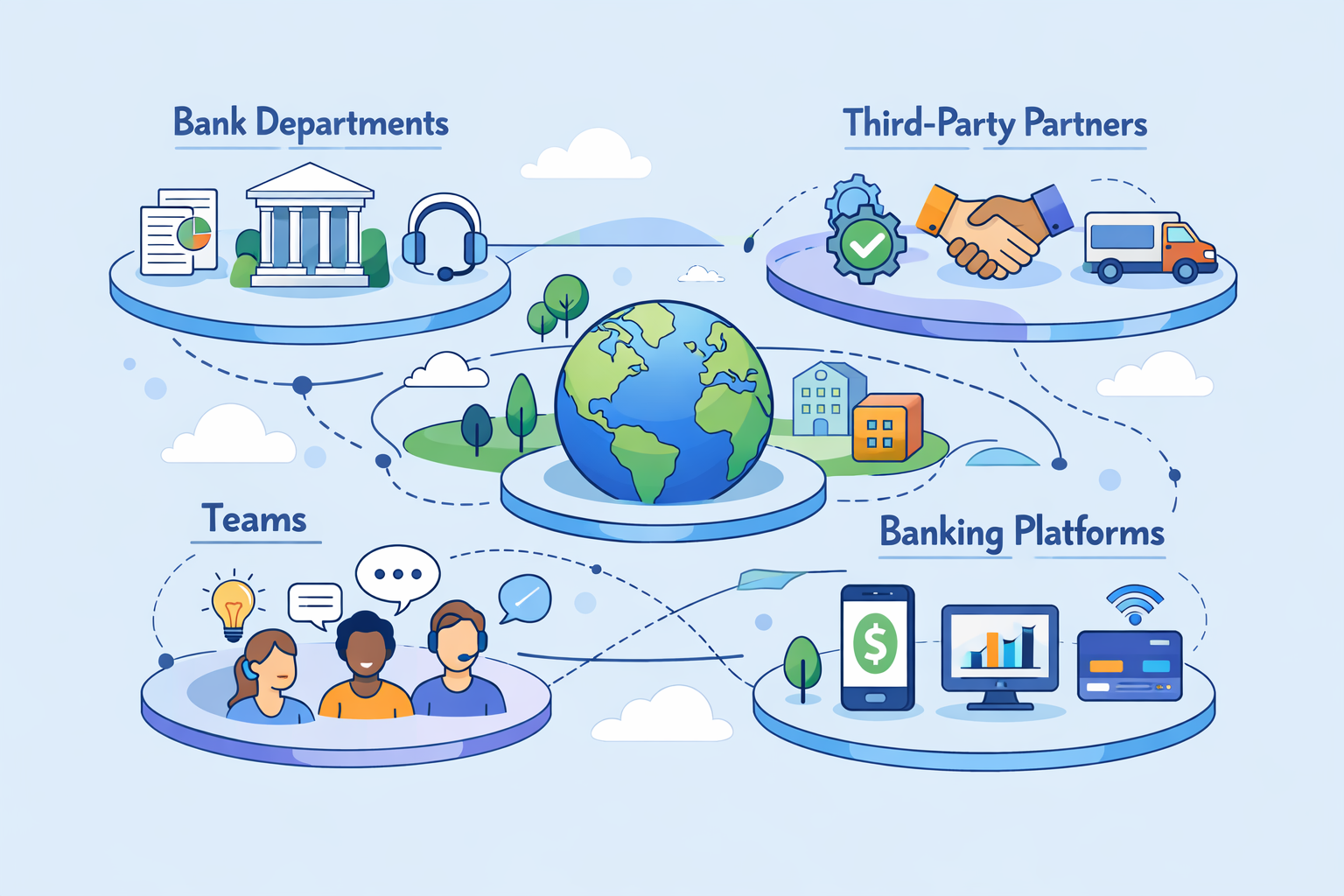
Commercial banking is an especially complex journey It has many stakeholders and relies heavily on third party partners. Manual tools have been the typical way to attempt orchestration of these disconnected steps. Email threads, shared inboxes, spreadsheets and phone calls have been doing heavy lifting they were not intended for.
“Customers blame the bank, not the partner. That’s why orchestration matters.” -Alan Finlay, Head of Product, OvationCXM
An effective operations orchestration platform, built for financial services, digitizes and templates end to end workflows, across different teams and organizations so they are visible to everyone involved. Everyone can see:
- What steps have to occur and in what order
- Who owns each step
- Which journey steps remain, and what comes next
- What conditions trigger progress, require escalation or indicate intervention
Why AI Won't Scale Without Orchestration
AI is data hungry. And banks arguably hold more personal data on their customers than nearly any industry. However, what they lack is the infrastructure to unify this data currently stored in different systems and formats inside the institution.
- Isolated AI models focused on one function
- No workflow visibility
- No cross-team context
- Manual coordination bottlenecks
- Governance fragmentation
The Impact of Scaling AI
Institutions that successfully scale AI across coordinated workflows outperform peers that deploy AI in isolated functions.
Industry estimates predict:
• Up to 50% boost in productivity and speed through human/AI collaboration.
• 2x customer retention using AI to proactively predict needs
• Up to 25% increase in decision-making times and accuracy
As Alan Finlay, Head of Product at OvationCXM, explains: “AI will be the most important customer experience investment banks make in this decade. But only if it’s built on a foundation of visibility, orchestration and control.”
Analysts are urging financial institutions to think AI-first and prioritize building the backbone on which it should be scaled. Orchestration platforms are fast becoming that essential foundation.
How Orchestration Enables Operations and AI Expansion
AI models must have visibility into the full breadth of the customer lifecycle to analyze and inform banking leaders how to maximze relationships, grow profitability and improve efficiency of their operations.
In a recent article, Peter Gassman noted five pillars that need to be orchestrated to scale AI:
- Data: Clean, connected and governed
- Technology: Eliminate data silos
- Processes: Integrate AI into routine daily work
- People: Humans will still oversee AI
- Governance: Deployed in a strict regulatory environment
“To automate even a single end-to-end workflow, banks must therefore orchestrate dozens of interdependent systems across the front-, middle-, and back-office. Basic integration becomes a major obstacle long before models can reach production.” -Peter Gassman, Senior Partner at Strategy&
Strategic Implications for Banking Leaders
- AI can only optimize CX processes it can access.
- Core banking systems are siloed, but well suited for conducting foundational functions. An orchestration platform that connects them enables coordinated journey execution across the ecosystem.
- AI delivers greater value when applied to coordinated end-to-end journeys, not isolated tasks.
- Establishing an orchestration layer is a foundational step to scale AI across enterprise operations.